AI in Compliance: How to Operationalize Artificial Intelligence in 2026

Artificial intelligence is no longer a future consideration for compliance teams — it’s an operational priority now.
Over the past three years, AI in compliance has shifted from cautious experimentation to enterprise-wide implementation. What began as curiosity around generative AI tools has evolved into structured discussions about governance, oversight, automation, and risk detection.
The real question for 2026 is no longer “Should we use AI in compliance?” It’s “How do we operationalize AI in compliance safely, effectively, and at scale?”
Andy Miller, SVP of Analytics and AI at Case IQ, explains, “I’d argue that 2026 is the year AI actually gets real for compliance and ethics teams.”
Here’s what that means and how compliance leaders can move forward strategically.
Learn how Case IQ's solutions can help you manage compliance risk from end to end
Looking to add AI in compliance processes at your organization? Book a call to see how you can do so effectively with our suite of tools.
The Evolution of AI in Compliance
In 2024, AI in compliance was largely theoretical. High-profile hallucination cases created hesitation. Andy notes, “There was a massive gap between the excitement about AI and what people were actually doing with it.” Most compliance platforms weren’t built with generative AI in mind. Traditional machine learning existed, but broad AI adoption felt risky.
By 2025, experimentation accelerated. Generative AI enabled domain experts to build and prototype without large engineering teams. That shift fundamentally changed the power dynamic.
“The value shifted from technical expertise to domain expertise. And for compliance professionals, that’s a big deal because you are the domain experts,” Andy says. However, rapid experimentation also introduced risk. Prototype-level tools are not the same as scalable, secure compliance infrastructure.
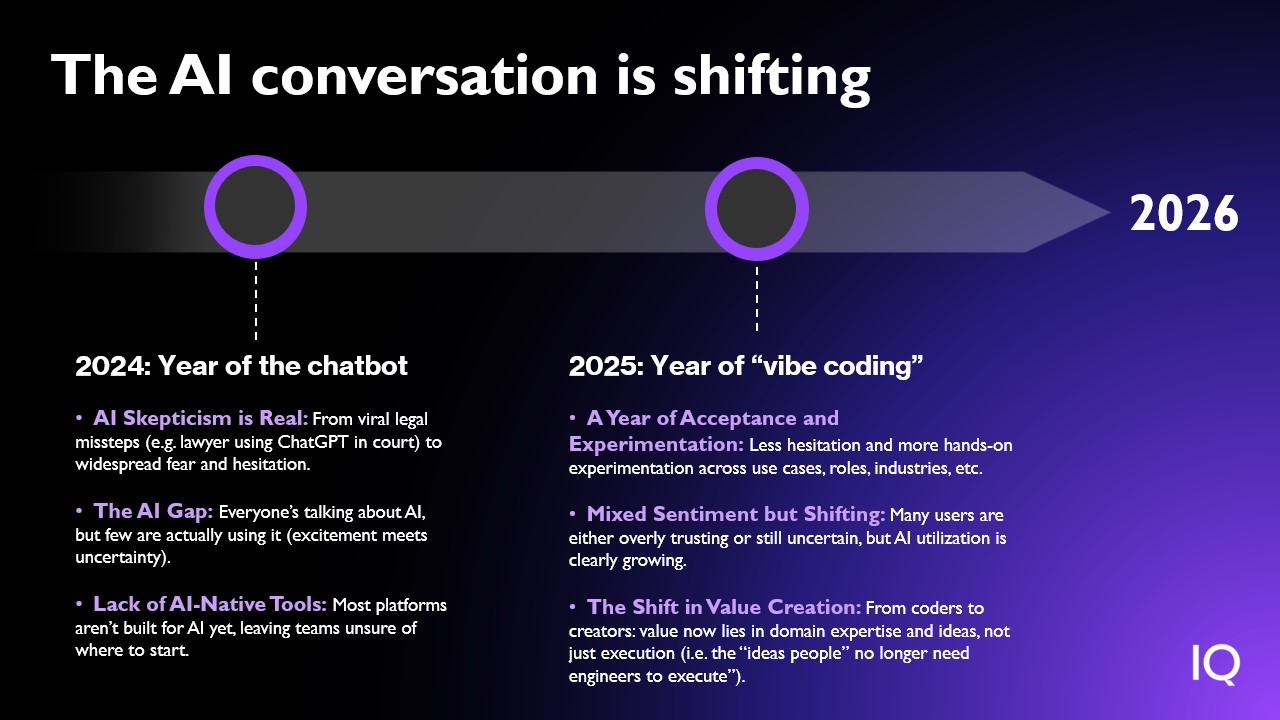
2026: The Year AI Gets Real for Compliance
What makes 2026 different? According to Andy, “We’ve moved past the ‘what is AI’ conversation.” AI is no longer a side tool. It is being embedded into compliance frameworks, workflows, and decision-making systems.
In our recent report, "2026 Essential AI Insights for Investigative & Compliance Teams," we found that:
- 42% of organizations plan to adopt AI for compliance within six months
- 72% believe AI can make compliance efforts more effective
- 70% feel comfortable using AI in workplace monitoring
The appetite for AI-powered compliance is clear. The differentiator is operational maturity.
What Does Operationalizing AI in Compliance Mean?
Operationalizing AI in compliance means embedding artificial intelligence into the infrastructure of your compliance program, not simply layering a chatbot on top of legacy systems.
It requires integration across processes including:
- Risk detection
- Case management
- Policy enforcement
- Third-party monitoring
- Whistleblower intake
- Reporting and analytics
Most importantly, it requires governance. Organizations must carefully create frameworks, policies, and other guardrails when adopting AI, especially for compliance.
Embedding Policies Into AI Systems
AI without policy context can cause inconsistencies, which can cause major risks for compliance teams.
Andy explains, “Without policy integration, AI is fundamentally probabilistic. It can give different answers to different people on different days for the same question. That’s generally fine for general knowledge tasks, but it’s completely unacceptable in compliance.”
Effective AI compliance solutions must be grounded in:
- Internal thresholds
- Regional regulations
- Approval workflows
- Historical case data
- Third-party risk signals
For example, AI evaluating a gift disclosure should assess your organization's relevant policy limits, government affiliations, and potential conflicts of interest instantly and consistently.
Supervised Autonomy: The Right Model for AI in Compliance
One of the most significant developments in AI for compliance is the rise of agentic systems capable of multi-step orchestration.
Before human review, an AI agent could:
- Receive a whistleblower report
- Categorize and triage the case
- Pull related case history
- Identify risk flags
- Draft a case summary
- Route to an investigator
However, autonomy must be supervised. Andy describes the correct model clearly: “What we’re really talking about is supervised autonomy. The AI can orchestrate a workflow end-to-end, but a compliance professional is in the loop and in control at the critical decision points.”
He also emphasizes, “Compliance teams don’t want to hand the keys over entirely, and they shouldn’t.” The higher the stakes, such as handling sensitive data and adhering to regulatory requirements, the stronger the human oversight should be.
Operationalizing AI in 2026 for an Evolving Compliance World
Watch Andy's entire presentation on adopting AI in your compliance programs by clicking below.
Where AI in Compliance Delivers Immediate Impact
AI for Risk Detection and Continuous Monitoring
AI-powered compliance monitoring enables:
- Automated transaction classification
- Risk pattern detection
- Confidence scoring
- Continuous monitoring at scale
This shifts compliance from reactive investigations to proactive prevention. The goal is not just automation, it’s smarter decision-making rooted in context.
AI for Investigation Efficiency
Case volumes and complexity continue to rise. AI in case management can:
- Triage reports to the right people
- Suggest next steps
- Generate case summaries
- Identify patterns across historical cases
AI becomes a highly capable analyst that takes care of tedious, time-consuming tasks.
“The best AI implementations treat AI as a highly capable analyst that does the heavy lifting — gathering data, identifying patterns, scoring risk — but always routes the decision to a human,” says Andy.
AI and Whistleblower Reporting
Our aforementioned AI report found that:
- 70% of North American employees have no concerns reporting incidents to AI-powered tools
- 78% believe AI can encourage safer reporting
For some employees, "speaking up" to an AI interface may feel less intimidating than speaking directly to HR or a manager, potentially increasing reporting transparency and frequency.
Governance Risks of AI in Compliance
AI introduces real risks if improperly deployed. Here are Andy's top considerations:
- Human Oversight Is Non-Negotiable: “AI should assist and not make the final call on high-risk decisions.” High-risk determinations (e.g., misconduct conclusions, sanctions, regulatory disclosures) must remain human-led.
- Centralization Prevents Chaos: Uncontrolled AI use across an organization creates inconsistency and risk. Enterprise-grade AI compliance platforms ensure consistent prompts, outputs, and auditability across global teams.
- Data Hygiene Matters More Than Ever: AI amplifies both strengths and weaknesses in data. Incomplete master data or poorly structured case records will degrade AI performance. Operational AI in compliance requires disciplined data stewardship.
2026 Essential AI Insights for Investigative & Compliance Teams
Download our recent report that surveyed over 2,400 global employees to learn more about how other organizations are using AI in 2026.
How Case IQ Can Help You Operationalize AI in Compliance
Successfully implementing AI in compliance requires more than experimentation; it requires purpose-built, secure, and governed technology.
For over 25 years, Case IQ has helped organizations reduce risk, mitigate incidents, and strengthen compliance programs. Today, we extend that foundation with AI-powered compliance solutions designed specifically for ethics and compliance teams.
AI-Driven Risk Detection
Case IQ’s compliance monitoring platform uses advanced analytics and machine learning to:
- Scan millions of transactions for corruption and fraud
- Automatically classify and score risk
- Continuously refine AI confidence scoring
- Enable proactive detection
AI operates within your compliance framework, ensuring you're consistent with both internal policies and external regulations.
Intelligent Case Management
Clairia, our AI assistant for case management, helps you with:
- Automated case triage
- AI-powered suggestions for next steps and case links
- Case summarization
- Pattern detection across investigations
Investigators stay in control while AI reduces administrative burden and accelerates resolution timelines.
Secure, Governed AI Infrastructure
Unlike consumer AI tools, Case IQ’s AI is embedded within a secure, enterprise-grade compliance environment.
We provide:
- Human-in-the-loop oversight
- Role-based access controls
- Audit trails
- Policy-aligned outputs
- Regulatory-aware deployment
This ensures your AI strengthens governance instead of introducing new exposure.
The Future of AI in Compliance
More than a quarter of organizations have not yet made changes to adopt AI. That gap represents risk, as well as opportunity.
Compliance leaders who operationalize AI responsibly will gain:
- Greater efficiency
- Stronger risk detection
- Improved investigative outcomes
- Enhanced regulatory defensibility
In 2026, AI in compliance is no longer optional — it’s foundational.
If your organization is ready to move from experimentation to execution, Case IQ can help you deploy secure, policy-aligned, and AI-powered compliance solutions with confidence. Request a demo of our solutions to learn more.
Ready to Transform Your Investigation Process?
Join 80,000+ professionals who trust Case IQ to streamline their case management and ensure compliance.


.avif)