Whistleblowing in Germany: Understand the Law and Build Your Reporting Process
Germany's whistleblower protection law requires employers with 50 or more employees and some financial firms with fewer employees, to run an internal reporting office, acknowledge reports within 7 days and give feedback within 3 months. This guide explains who is covered, what your whistleblowing system must offer, how timing and enforcement work and how to put a compliant reporting process in place across your German entities.
Who Does This Guidance Apply To?
The duty to run an internal reporting office generally applies where an employer has at least 50 employees. Assess each employer entity separately rather than relying only on the group's global headcount. Employers with 50 to 249 employees may share a channel with other employers, but each remains responsible for follow up and for putting right any violation.
Certain financial sector employers must run an internal reporting office whatever their size. These include credit institutions, investment and securities firms, insurers, capital management companies, data reporting service providers, stock exchange operators, payment institutions and crypto-asset service providers. A small workforce does not remove the duty: the regulated activity is what matters.
Public employers are covered too, but the rules work differently. Where the federal government or a state is the employer, its supreme authorities decide which units must set up reporting offices. For municipalities, municipal associations and the companies they control, the duty follows the relevant German federal state law.
Understand the Rules and Put Them Into Practice
The German Whistleblower Protection Act [Hinweisgeberschutzgesetz, HinSchG] has applied since 2 July 2023. It implements the EU Whistleblower Directive and goes further. The Act protects people who report wrongdoing at work, requires employers to give them a safe internal route and makes retaliation against them unlawful.
It protects anyone who learns of violations through their work, including employees, trainees, civil servants, self-employed contractors, suppliers' staff, shareholders, board members, job applicants and former employees. People who help a whistleblower, or who are named in a report, are protected too.
Reportable concerns are broader than under the EU Whistleblower Directive. These include all criminal offences, administrative offences which protect life, health or employees' rights, and breaches of EU and German law in areas such as procurement, financial services, money laundering, product safety, environmental and data protection, competition and tax.
At the heart of whistleblower protection law is the internal reporting office: the person or team who receives reports, checks them, takes follow up action and gives feedback. The employer must set it up, give it the powers it needs and keep it independent. Whistleblowers can still choose to report to an external authority instead.
Example: a warehouse supervisor reports that safety inspections are being signed off without checks. The internal reporting office acknowledges the report, investigates and reports back, and the supervisor is protected from any detriment.
Every employer in scope must set up an internal reporting office [interne Meldestelle] and the reporting channels that feed it. Together they form your whistleblowing system [Hinweisgebersystem].
• Reporting routes: channels must accept reports orally, by phone or another voice system and in writing. If a whistleblower asks, you must offer an in-person meeting within a reasonable time or a video meeting with their consent.
• Independent handlers: the people who run the office must be independent in that role, have the necessary expertise and have no conflicts of interest with their other duties. They can be employees, such as a compliance officer, or an external ombudsperson.
• Confidentiality and anonymity: the identity of the whistleblower and anyone named in a report must stay confidential and only the people handling reports may see them. The office should also process anonymous reports but the law does not require a channel for anonymous reporting.
• Records: document every report in a permanently retrievable form. Documentation is generally deleted three years after the procedure ends. The GDPR also applies and a data protection impact assessment (DPIA) is usually needed.
Group arrangements need care. The German legislator accepts a parent company running a central office as a 'third party', but the European Commission takes a stricter view. Each German subsidiary with 50+ employees remains responsible for follow up and an accessible local channel. Introducing reporting channels, especially software, usually requires the works council's involvement.
Example: a group runs one whistleblowing platform from its Paris headquarters. Its Munich subsidiary, with 120 employees, names a local compliance manager as owner, so reports about Munich are followed up in Germany and the subsidiary can show it remains responsible.
The Act sets two deadlines for the internal reporting office (section 17):
• Acknowledgement: confirm receipt to the whistleblower within 7 days.
• Feedback: give feedback within 3 months of the acknowledgement. If no acknowledgement was sent, the deadline is 3 months and 7 days after the report was received.
Feedback must explain the follow up measures planned or already taken, and the reasons for them, as far as this does not affect internal investigations or the rights of the people named in the report.
Calculate both deadlines from the date the report arrives, not the date someone opens it, and set reminders before each one. Name a backup owner for every report, so holidays, sickness or a conflict of interest do not cause a missed deadline.
Feedback is not the same as closure. Three months is often too short to finish an investigation, but the whistleblower must still hear what follow up is under way. Keep the case open and send further updates until it ends. External reporting offices work to the same deadlines, extendable to 6 months in complex cases.
Example: a report about falsified test data arrives on 2 March and is acknowledged on 5 March, so feedback is due by 5 June. On 1 June, the handler tells the whistleblower that the investigation continues, which steps are under way and when to expect the next update.
Enforcement of German whistleblower protection law rests with several bodies, each separate from your internal reporting office:
• The Federal Office of Justice runs the federal external reporting office, which received 1,802 reports in 2024. BaFin handles financial services and the Federal Cartel Office handles competition matters. Several federal states run offices for state and municipal matters.
• Whistleblowers can report to these bodies instead of internally. You may encourage internal reporting, but you cannot prevent or penalise external reporting.
Whistleblower protection centres on a ban on retaliation, including threats and attempts. If a whistleblower suffers a detriment after reporting, the law presumes it was retaliation and the employer must prove otherwise. A whistleblower can claim compensation for financial loss but has no right to a job or promotion.
Fines depend on the breach:
• failing to set up or run a required internal reporting office: up to €20,000
• obstructing a report, retaliating or breaching confidentiality intentionally or recklessly: up to €50,000 for managers, rising to €500,000 where the company itself is fined for a manager's breach
• knowingly disclosing false information publicly: up to €20,000
Courts are still shaping the rules. In December 2025, the German Federal Labour Court held that protection requires an actual report - a dismissal decided before the report was not retaliation.
Example: an employer dismisses a whistleblower two weeks after a report. Without dated records showing an unrelated reason decided earlier, it is unlikely to rebut the presumption.
Implementation is easier as six practical actions:
1. Document which German entities are covered, with headcount, sector and any shared or group arrangement.
2. Assign an owner, a deputy and a route for conflicts of interest, so no report is handled by someone it concerns.
3. Test every reporting route, including phone and voice messages, written reports and requests for a meeting.
4. Set reminders for receipt, the 7-day acknowledgement and the 3-month feedback deadline.
5. Approve who can access reports, how long records are kept and how suspected retaliation is escalated.
6. Review staff communications, and complete any works council steps before launching or changing the reporting procedure.
Keep track of change. The government's evaluation of the Act is overdue, the European Commission's review of the EU Whistleblower Directive is due by the end of 2026 and a pending Federal Labour Court appeal may clarify what counts as a protected report.
Example: the HR director of a German subsidiary owns action 3. The evidence is a dated test call, a test written report and a log showing both reached the internal reporting office, reviewed by group compliance each quarter.
Build Trust and Strengthen Whistleblower Reporting with Case IQ
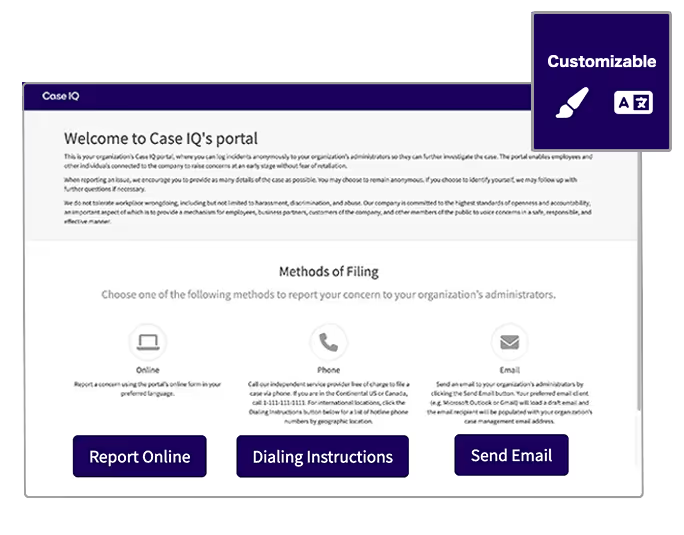
Empower employees and stakeholders to speak up safely and confidently with Case IQ's secure, accessible and multilingual whistleblower hotline. With 24/7 reporting, anonymous and confidential reporting options, and seamless integration with investigative case management, Case IQ helps organisations capture concerns early, protect reporter identities and manage every report from intake through to resolution.
- Accessible, multi-channel reporting: Give employees, business partners and the public convenient ways to raise concerns through a 24/7/365 live-answer hotline, web forms, email and mobile-friendly reporting, with multilingual support.
- Secure, confidential follow-up: Enable two-way communication with reporters, including those who choose to remain anonymous, while protecting sensitive information through role-based access controls.
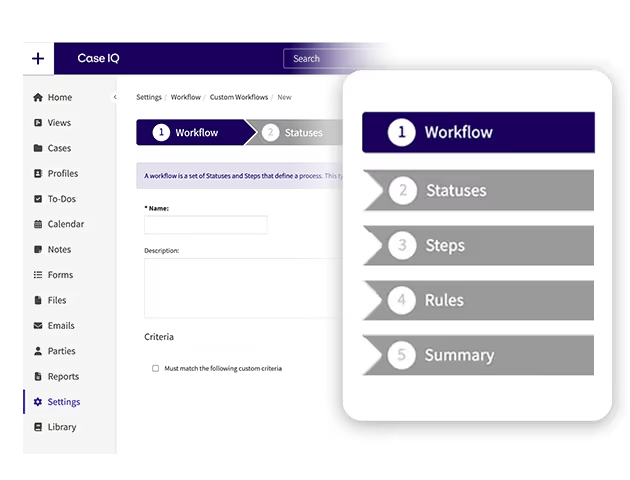
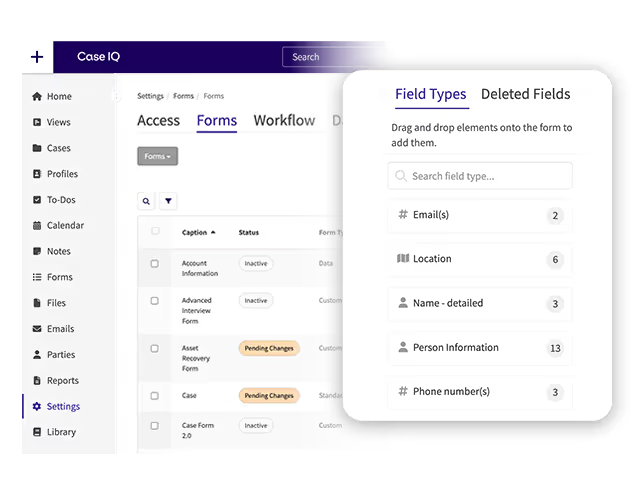
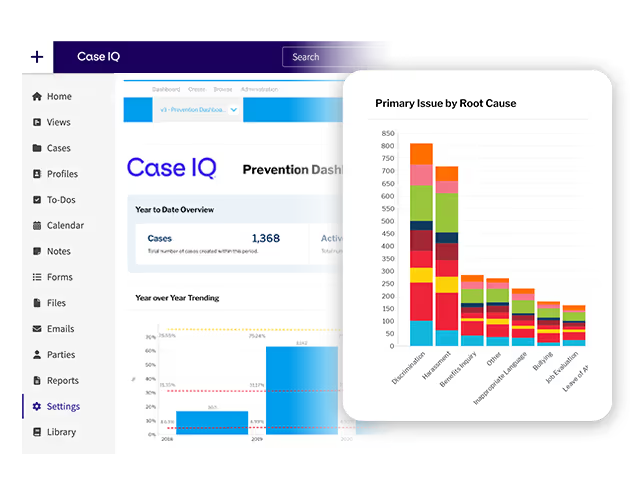
- Streamlined case management: Automatically capture and route reports into Case IQ's case management platform, where teams can document investigations, track actions and maintain a clear audit trail through to resolution.
- Stronger programme oversight: Use reporting dashboards and case analytics to identify trends, monitor outcomes and strengthen accountability, while maintaining organisational responsibility for reporting policies, investigation procedures and whistleblower protection.
FAQs
No. Software can provide secure reporting channels, but compliance depends on how you run them. You still need an independent, trained internal reporting office, a follow-up process, the 7-day and 3-month deadlines, confidentiality and protection from retaliation. The works council usually needs to be involved before a system is introduced.
No. A hotline is the reporting channel. The internal reporting office is the person or team that receives reports, checks them, follows up and gives feedback. The Act requires both oral and written channels, so a phone hotline alone is not enough. The office must also be independent, have the right expertise and offer a meeting if a whistleblower asks.
Partly. You can appoint a third party, such as an external ombudsperson or specialist provider, to run your internal reporting office, but you remain responsible for stopping any violation and for follow-up. Employers with 50 to 249 employees may also share an office. For group-wide solutions, keep local responsibility in each German subsidiary, because the European Commission takes a stricter view.