Whistleblowing in Switzerland: Reporting Guidance for Employers
Whistleblowing in Switzerland works differently from the EU. There is no general whistleblowing law and employees who report externally too early can face dismissal or prosecution for breaching confidentiality. That makes it important to have clear Swiss reporting procedures. This guide explains which employers and workers are affected, what Swiss laws require and how to build a whistleblowing policy to encourage internal reporting.
Who Does This Guidance Apply To?
Switzerland has no whistleblowing statute and no headcount threshold for private employers. The Swiss Code of Obligations governs private employment: employees owe their employer loyalty and confidentiality, and the employer must protect their health, dignity and privacy at work, including from harassment (Persönlichkeitsschutz, set out in Article 328). In practice, this guidance applies to any employer with staff in Switzerland, any worker who raises a concern and any activity where a report could involve confidential information.
Private employers have no legal duty to run a reporting channel. However, boards must organise the company and its internal controls, and companies can be liable for offences such as bribery if their organisation is deficient. A reporting procedure is therefore a voluntary policy commitment with legal value. Good practice includes a named owner, confidential and anonymous routes, trained handlers and documented follow up.
Federal employees must report crimes and may report other irregularities to the Swiss Federal Audit Office, which protects them from discrimination. Several cantons and cities have their own rules for their staff. FINMA-supervised institutions face supervisory expectations on controls. Overseas entities follow local law: EU subsidiaries with 50+ workers must meet their country's whistleblowing rules.
Understand the Rules and Put Them Into Practice
Whistleblowing in Switzerland has no dedicated law. Parliament rejected a bill to protect private sector whistleblowers in March 2020 plus a further motion in February 2024 and no new legislation is planned. Swiss whistleblowing therefore rests on general rules that apply differently to different employers:
• Private employers: the Code of Obligations governs employment. Employees owe a duty of loyalty and confidentiality and courts decide case by case whether a report was lawful. They generally expect employees to report internally first, then to a competent authority and to go public only as a last resort.
• Federal employees: the Federal Personnel Act requires them to report crimes, lets them report other irregularities to the Swiss Federal Audit Office and protects them from discrimination.
• Cantonal and municipal staff: several cantons and cities have their own rules and reporting offices.
• Regulated sectors: banks, insurers and other FINMA-supervised institutions work under supervisory expectations and strict secrecy rules.
The EU Whistleblower Directive is not Swiss law but it applies through local law to EU subsidiaries of Swiss groups.
Because the law offers limited protection, having a clear whistleblowing policy matters. It gives employees a safe internal route and helps the company detect problems first.
Example: an engineer at a Zurich manufacturer suspects a supplier is paying bribes. Because she knows the internal channel, she reports there rather than to the press and the company can investigate before an external authority does.
Swiss reporting procedures combine legal duties with good practices. Keep the two apart in your whistleblowing policy.
Legal duties that apply include:
• Boards must organise the company and its financial control, and larger companies must have an internal control system which the auditor checks (Articles 716a and 728a of the Code of Obligations).
• A company is criminally liable for bribery, money laundering and certain other offences if it fails to take all reasonable organisational measures to prevent them under Article 102 of the Swiss Criminal Code. A working whistleblowing system helps show adequate organisation.
• Employers must protect employees' “personality rights” under Article 328 of the Code of Obligations while employees must respect confidentiality, including banking and business secrecy.
• The revised Federal Act on Data Protection applies to reports. Inform people about processing, keep data secure, limit access, set retention periods and carry out an impact assessment where risk is high. Access requests can be restricted to protect the whistleblower. If reports are handled outside Switzerland, check the rules on cross-border data transfers.
Good practice, drawn from ISO 37002, includes a named whistleblowing owner with a deputy, a conflict of interest check, several channels, confidential reporting with an anonymous option, trained handlers and documented follow up. Confidentiality protects a known reporter's identity.
Assess EU operations separately. EU subsidiaries of a Swiss group with 50+ workers must meet local whistleblowing law in each country, even though the Swiss parent has no such duty.
Example: a Basel pharmaceutical group runs one whistleblowing system. Its Swiss entity follows a voluntary policy, while its 200 person German subsidiary configures the same system to meet German deadlines and local ownership.
Swiss law sets no deadlines for acknowledging or following up whistleblowing reports. Any timetable in your reporting procedure is an employer service standard, not a legal duty, and your policy should say so. EU subsidiaries must still meet their national statutory deadlines.
Suggested internal service standards:
• Receipt: log every report on the day it arrives, with its date and channel.
• Acknowledgement: confirm receipt within a few working days, for example five.
• Assessment: decide within 2 to 4 weeks whether to investigate, refer or close the report.
• Updates: tell the reporter about progress at regular intervals, for example every 6 to 8 weeks, as far as confidentiality allows.
• Escalation: send serious matters, such as suspected bribery or money laundering, to your legal team or the board within an agreed time.
Name a backup owner for every report, so holidays, sickness or a conflict of interest do not stall the follow up. Keep an ongoing investigation open until it ends and keep the reporter informed.
Two legal clocks still matter in dismissal disputes: an employee who considers a dismissal abusive must object in writing before the notice period ends and sue within 180 days after employment ends under Article 336b of the Code of Obligations.
Example: a report arrives through the web channel on a Friday. The owner is on leave, so the deputy acknowledges it on Monday and records the assessment decision two weeks later.
Swiss whistleblowing has no single authority and no EU-style enforcement regime. Each external reporting route has a defined remit:
• Swiss Federal Audit Office (SFAO): receives reports of irregularities, corruption or other unlawful acts in the federal administration, organisations close to the Confederation and recipients of federal subsidies, through a secure platform that allows anonymous reports.
• FINMA: receives reports from insiders about breaches at institutions it supervises. FINMA expects reporters to try internal reporting first and turn to FINMA only if that fails or seems futile. Otherwise, they risk prosecution for breaching a duty of confidentiality.
• Federal Data Protection and Information Commissioner (FDPIC): intervenes only in significant breaches of data protection law. It cannot award compensation or act for individuals and a person who reports a breach is not party to the proceedings.
Oversight, employment remedies and criminal proceedings are separate. An employee dismissed for reporting in good faith can claim up to 6 months' wages for abusive dismissal in the civil courts but cannot be reinstated. Disclosing secrets outside permitted channels can lead to prosecution and companies face fines of up to CHF 5 million for organisational failures plus compensation claims.
Reporter protection therefore depends largely on the employer: keep identities confidential and document the reasons for any measure affecting a reporter.
Use this checklist to plan implementation:
1. Verify which entities and sectors are in scope, including FINMA-supervised entities and EU subsidiaries.
2. Appoint an owner, a deputy and a route for conflicts of interest.
3. Select accessible channels in the languages your workforce uses such as German, French, Italian and English.
4. Review data handling and access under the revised Federal Act on Data Protection.
5. Set internal response targets and label them as service standards.
6. Train handlers and managers on confidentiality, secrecy duties and retaliation.
7. Test submission and follow up from start to finish, including anonymous reports.
8. Review the whistleblowing policy and reporting process at least once a year.
Watch for change. No Swiss law is planned, but OECD pressure continues and court cases on corporate liability will shape what 'all reasonable organisational measures' means.
Example: the head of compliance at a Geneva trading company owns step 7. The evidence is a dated anonymous test report, the deputy's acknowledgement and the follow up message, saved in the case log for the annual review.
Build Trust and Strengthen Whistleblower Reporting with Case IQ
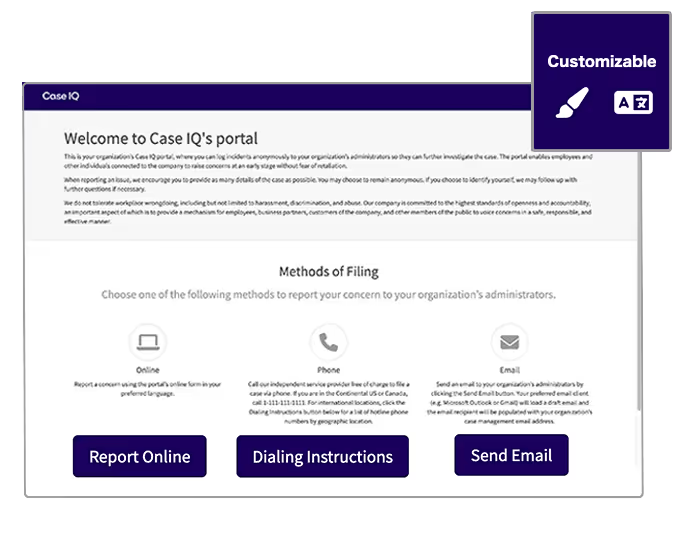
Empower employees and stakeholders to speak up safely and confidently with Case IQ's secure, accessible and multilingual whistleblower hotline. With 24/7 reporting, anonymous and confidential reporting options, and seamless integration with investigative case management, Case IQ helps organisations capture concerns early, protect reporter identities and manage every report from intake through to resolution.
- Accessible, multi-channel reporting: Give employees, business partners and the public convenient ways to raise concerns through a 24/7/365 live-answer hotline, web forms, email and mobile-friendly reporting, with multilingual support.
- Secure, confidential follow-up: Enable two-way communication with reporters, including those who choose to remain anonymous, while protecting sensitive information through role-based access controls.
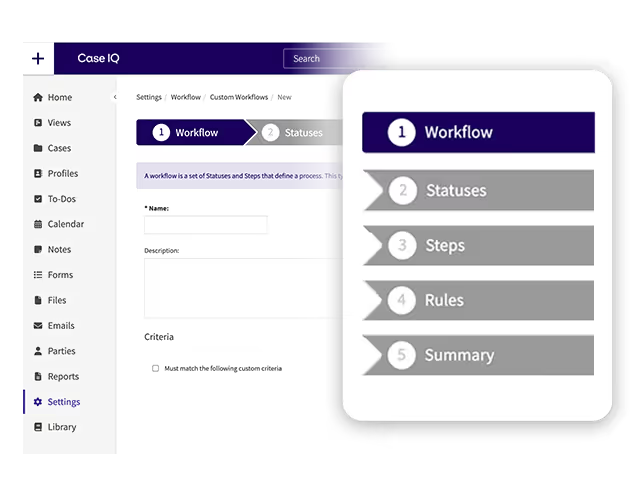
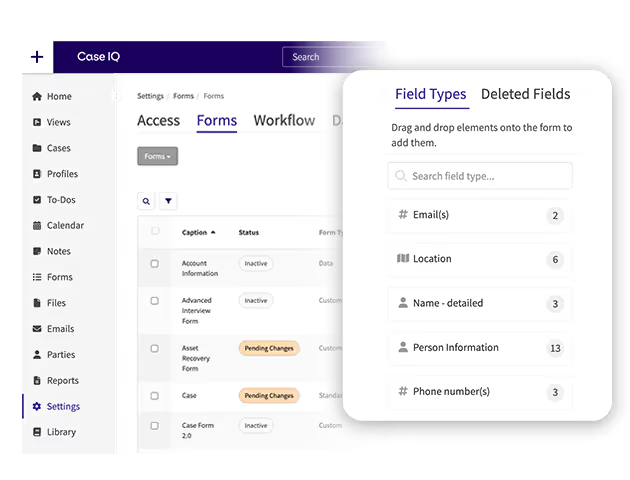
- Streamlined case management: Automatically capture and route reports into Case IQ's case management platform, where teams can document investigations, track actions and maintain a clear audit trail through to resolution.
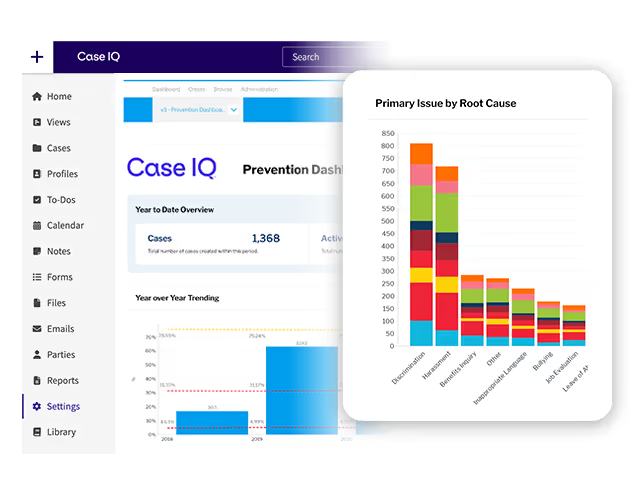
- Stronger programme oversight: Use reporting dashboards and case analytics to identify trends, monitor outcomes and strengthen accountability, while maintaining organisational responsibility for reporting policies, investigation procedures and whistleblower protection.
FAQs
Start with the law: no Swiss statute makes a reporting channel mandatory but boards must maintain internal controls and companies can be liable for offences such as bribery if poorly organised. Then add good practice: a named owner, confidential and anonymous routes, trained handlers, data protection safeguards and a clear internal-first route.
Swiss law sets no deadlines for handling whistleblowing reports, so any timing is an employer service standard. A procedure should set targets for acknowledgement, assessment, updates and escalation, and name a backup owner. EU subsidiaries must still meet their local statutory deadlines. Legal time limits do apply to abusive dismissal claims under the Code of Obligations.
Explain the internal route first, because Swiss courts and FINMA expect it to be tried before external reporting. Then explain the external routes that fit your organisation: the Swiss Federal Audit Office for federal matters, FINMA for supervised institutions and the FDPIC for data protection. Public disclosure is a last resort and can breach confidentiality duties.